15 Afro Bohemian Interior Design Ideas for a Warm and Layered Home
Most people trying to pull off Afro Bohemian design don’t have a taste problem. They have an order-of-operations problem.
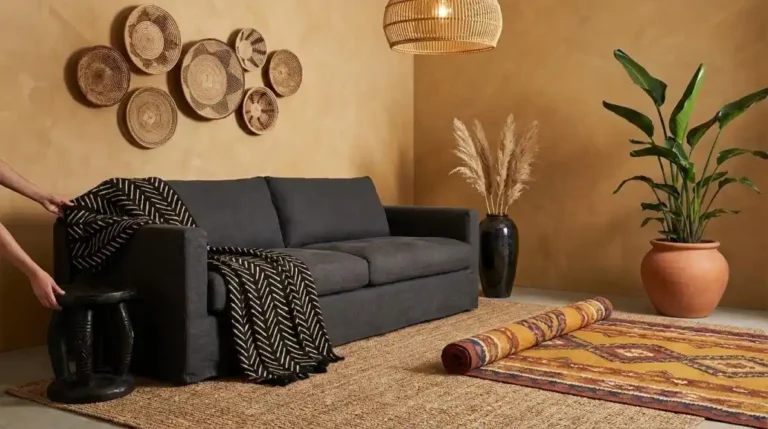
They start with a sofa, add some plants, hang something on the wall, and wonder why the room looks assembled rather than lived-in. The style doesn’t work that way. It’s built from the inside out — textiles first, then furniture, then lighting, then objects.
These 15 ideas follow that sequence. Each one is a specific design move with a specific reason behind it — not a vibe suggestion, but an actionable decision you can make in the next room you’re working on.
Quick Takeaway:
- Start with your anchor textile — everything else in the room should be chosen in
- response to it.
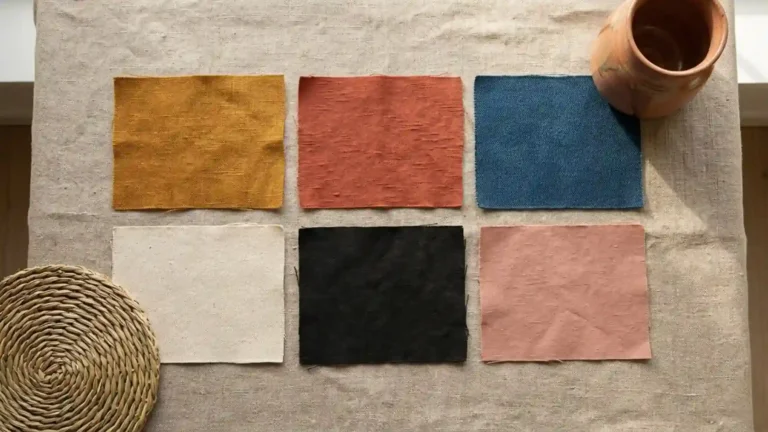
- Earth pigments only: ochre, terracotta, indigo, warm black, and raw linen are the palette boundaries.
- Lighting temperature is non-negotiable — 2700K warm, or the palette reads wrong.
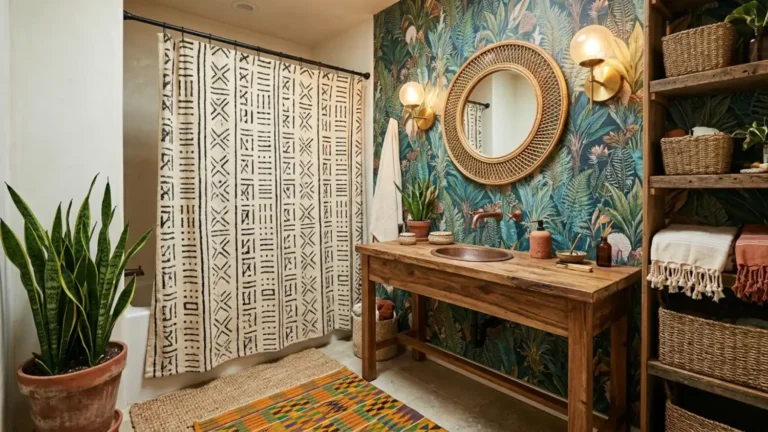
1. Start With a Mud Cloth Anchor Piece
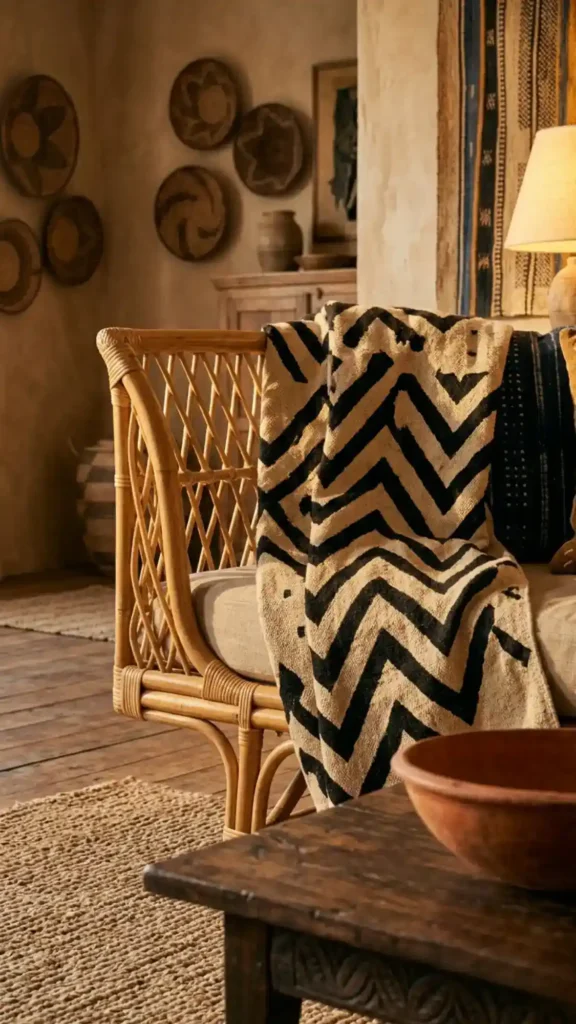
Mud cloth — bogolan from Mali — is the load-bearing textile of the Afro Bohemian aesthetic.
Its black and cream geometric patterns carry enough visual weight to anchor an entire room composition around them. Before you buy a single piece of furniture, find your mud cloth piece: a throw, a cushion set, or a wall-hung panel.
Every other color and material decision in the room gets made in response to it. That’s not limiting — it’s the structural logic that prevents the room from reading as random.
2. Build the Palette From Three Earth Pigments Maximum
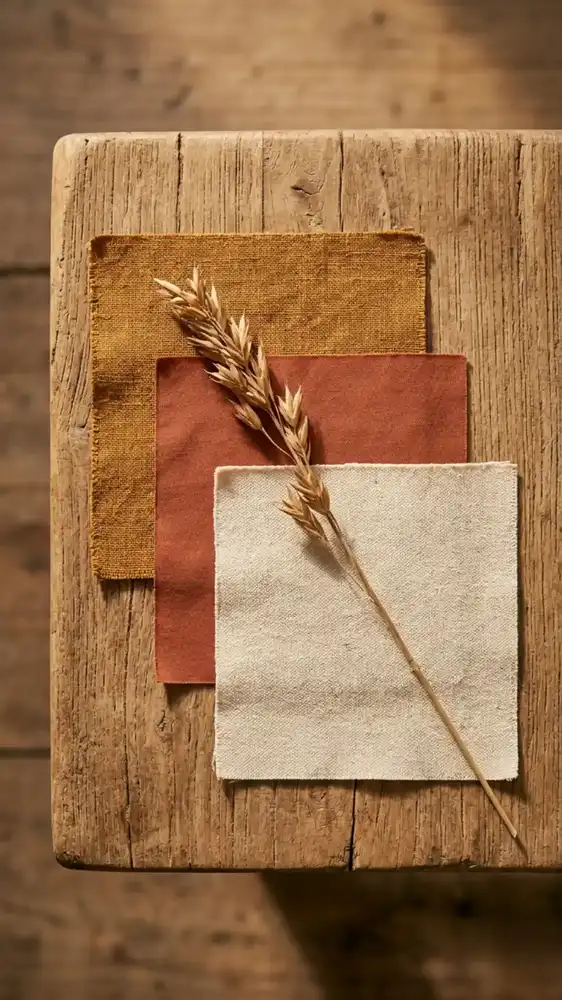
The Afro Bohemian palette fails when too many earth tones compete at equal weight.
Choose three: one dominant (ochre or warm sand), one supporting (terracotta or raw sienna), one accent (indigo or warm black). Raw linen serves as the neutral between them — not white, not grey.
Three-pigment discipline keeps the room warm without reading muddy. Every additional color you introduce has to earn its place by contrasting against — not blending into — these three.
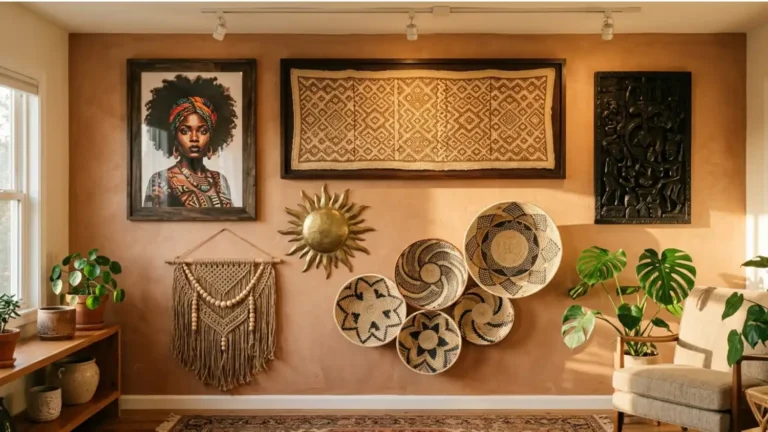
3. Hang a Woven Tapestry as the Primary Wall Treatment
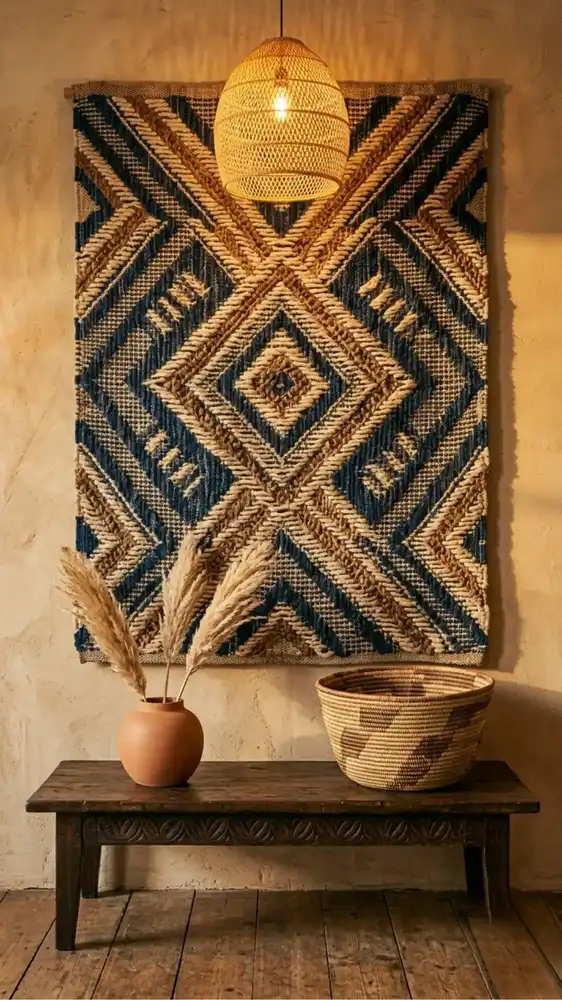
In most Western interiors, wall art is secondary. In Afro Bohemian design, the wall textile is often the most architecturally significant element in the room.
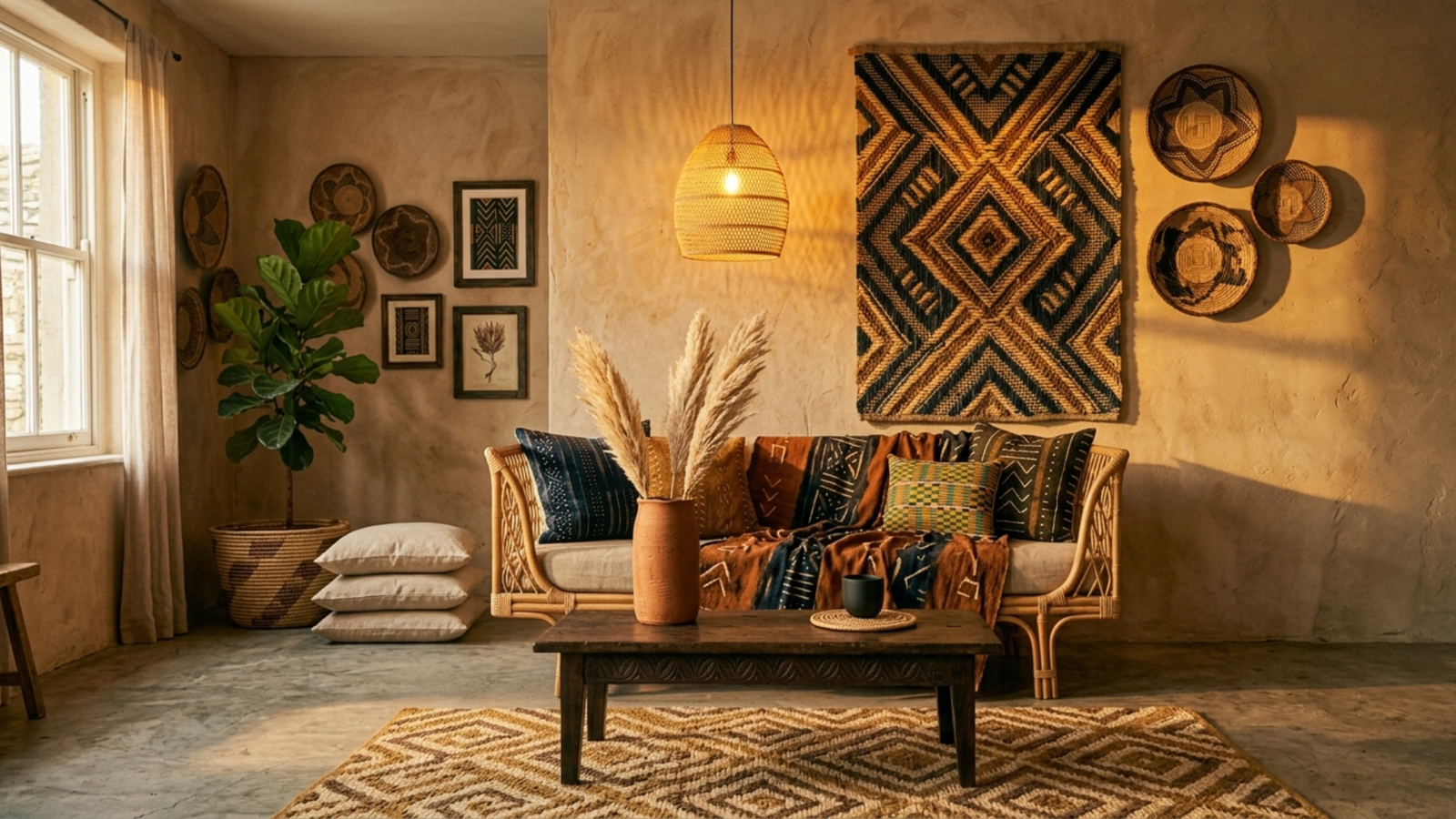
A large woven tapestry — 120cm wide minimum — functions as the room’s visual anchor point. Everything positioned in front of it is framed by it.
Choose a tapestry with geometric pattern in the earth palette. The fiber texture also adds a third dimension to the wall that flat art or paint can’t produce — and the natural fiber weave will catch 2700K light in a way that shifts with time of day.
4. Keep Furniture Low and Solid
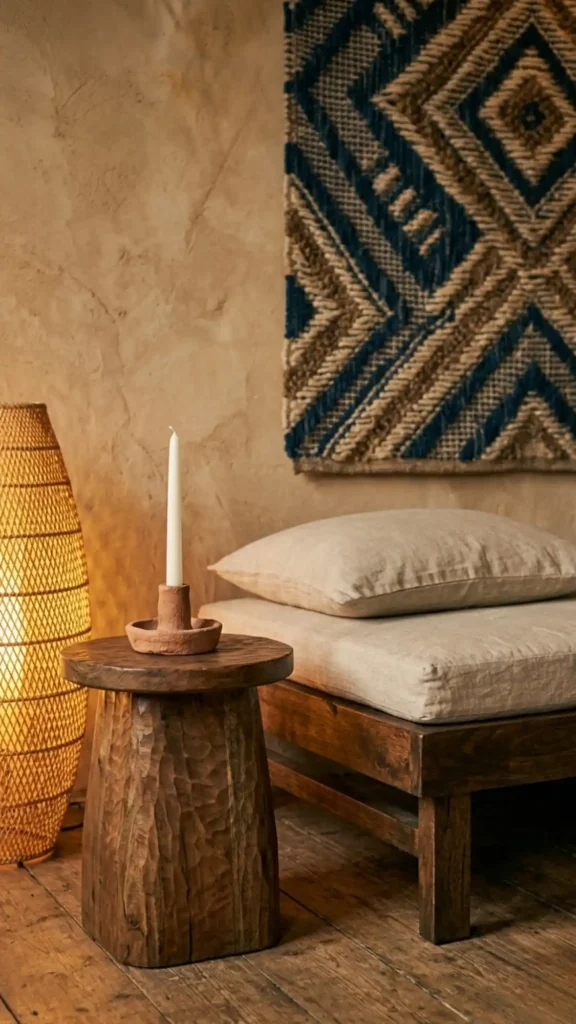
Low furniture grounds the room and shifts the visual weight toward the floor — where the rug and textile layers live.
Platform beds, squat wooden stools, low rattan armchairs, coffee tables that sit at ankle height. The silhouettes should feel settled, not elevated.
High-legged, tapered furniture references a different design tradition and creates a visual contradiction with the handmade, earth-weighted aesthetic. Keep the furniture profile close to the ground and let the layered textiles rise above it.
5. Use a Patterned Rug as the Room’s Floor Anchor
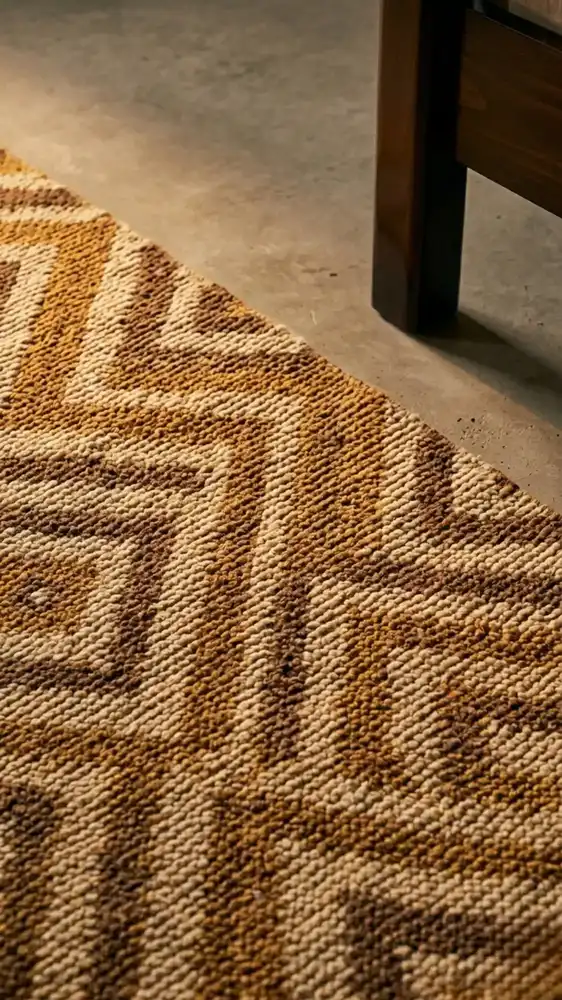
The rug defines the room’s ground plane and establishes the pattern logic everything above it responds to.
In Afro Bohemian design, the rug should be large — floor-filling, not floating in the center — and geometric in pattern. Diamond repeats, interlocking chevrons, and linear border patterns in earth tones all work.
The rug carries the mid-scale pattern layer. Your wall tapestry handles the large scale. Your cushions and throws handle the small scale. Get this three-tier hierarchy right and the room holds any number of patterns simultaneously without reading as chaotic.
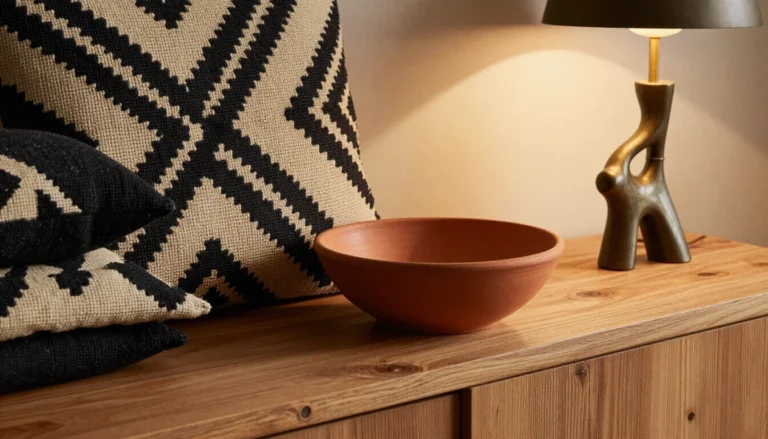
6. Add a Terracotta Vessel as the Key Object
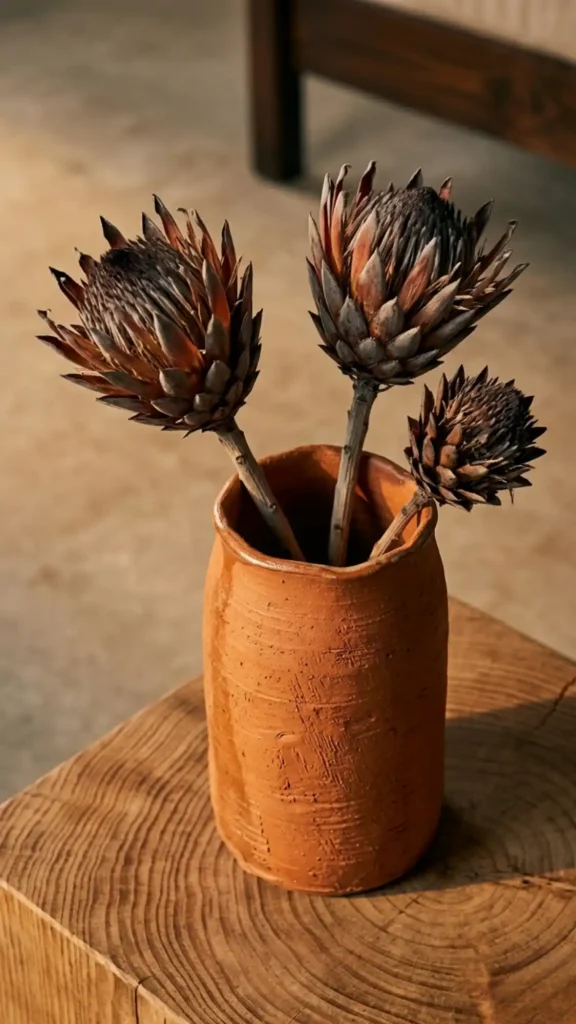
Terracotta — hand-thrown, unglazed, slightly irregular — is the object that ties the color palette to the material logic.
It references the earth pigment palette literally: the fired clay color matches ochre and raw sienna without effort. It also carries visible handcraft — the slight lip irregularity, the tool marks on the surface — that machine-made ceramics can’t replicate.
One large terracotta vessel is enough. Two becomes a theme. Three becomes a collection. Use it as the focal point object in a vignette and let the textiles frame it.
7. Mix Patterns at Three Distinct Scales
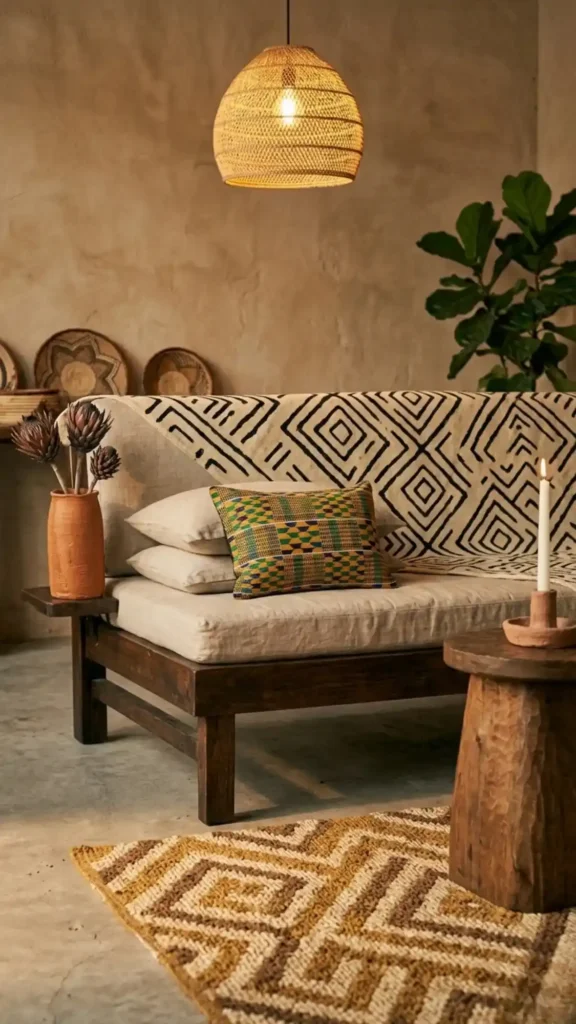
Pattern mixing fails when two patterns occupy the same visual scale in the same frame.
The fix isn’t fewer patterns — it’s better scale separation. Large pattern at the wall or sofa level. Mid-scale pattern at the floor level. Small-scale pattern at the cushion or ceramic detail level. Each pattern occupies a distinct perceptual distance from the viewer, so the eye reads them sequentially rather than simultaneously.
This three-tier structure can hold five different patterns in one room without visual noise. The patterns don’t need to match — they need to be legible at different distances.
8. Install Warm Lighting at Multiple Heights
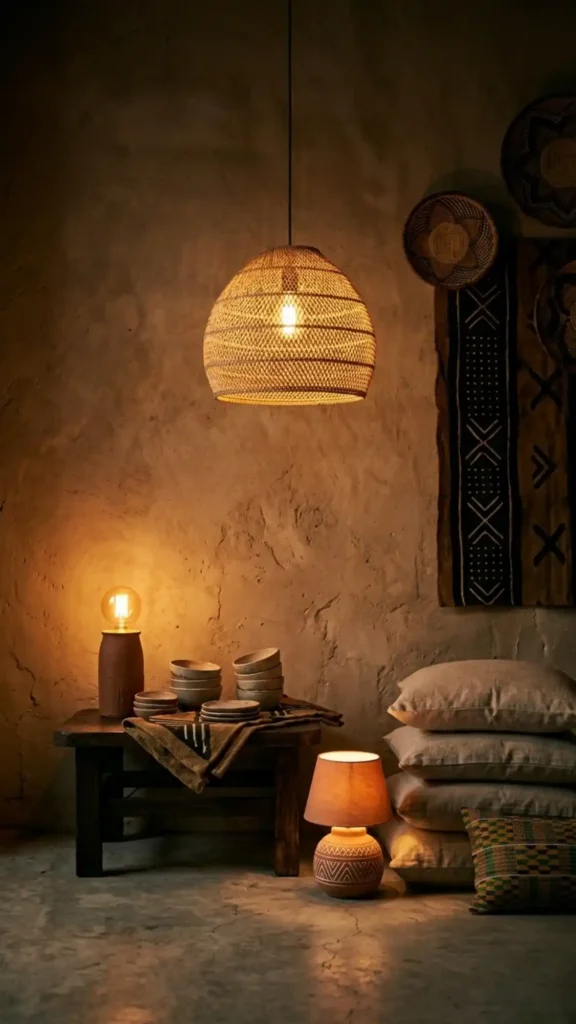
Single overhead lighting flattens every material surface in the room.
Afro Bohemian design needs light at three heights: a pendant or ceiling fixture, a table lamp at seated eye level, and a floor lamp or low candle source. The three zones create areas of intensity and shadow — and shadow is what makes texture visible.
Every light source should run at 2700K warm. Cool-white bulbs don’t just change the mood — they chemically shift the earth pigments, pushing ochre toward green and terracotta toward grey. The palette is correct only under warm light.
9. Choose a Rattan Pendant Over a Solid Shade
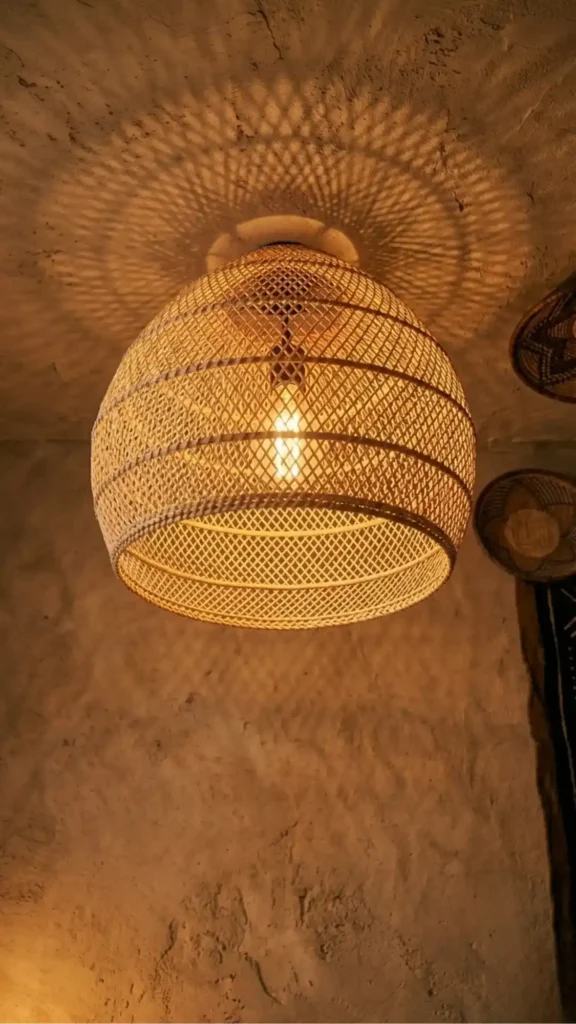
A rattan pendant does two things simultaneously: it provides directional warm light and it casts geometric shadow projections onto surrounding surfaces after dark.
The open weave casts patterns that shift as the light source warms up — and that layered light-and-shadow effect adds a fifth dimension to a room that’s already working in color, texture, pattern, and form.
Solid fabric or metal shades block this effect entirely. Rattan, woven seagrass, or open-weave natural fiber pendants are the correct fixture material — not as a style choice but as a functional one.
10. Use Dried Botanicals, Not Fresh Flowers
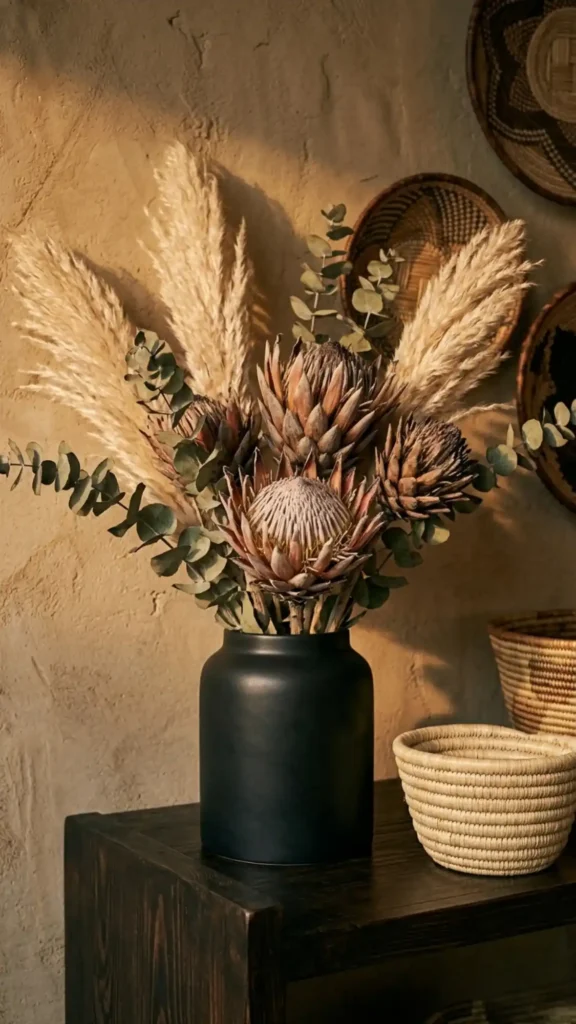
Fresh flowers in an Afro Bohemian room introduce a softness that works against the aesthetics material logic.
Dried botanicals — pampas grass, protea, preserved eucalyptus, dried seed pods — have a textural presence that reads as an extension of the natural fiber vocabulary rather than a contrast to it. The muted, faded tones of dried plant matter also sit within the earth palette naturally, where fresh green and bright blooms pull attention toward a different color register.
Dried arrangements also last indefinitely. The room benefits from the texture long-term without the maintenance cycle that fresh flowers require.
11. Add a Coiled Grass Basket as a Functional Object
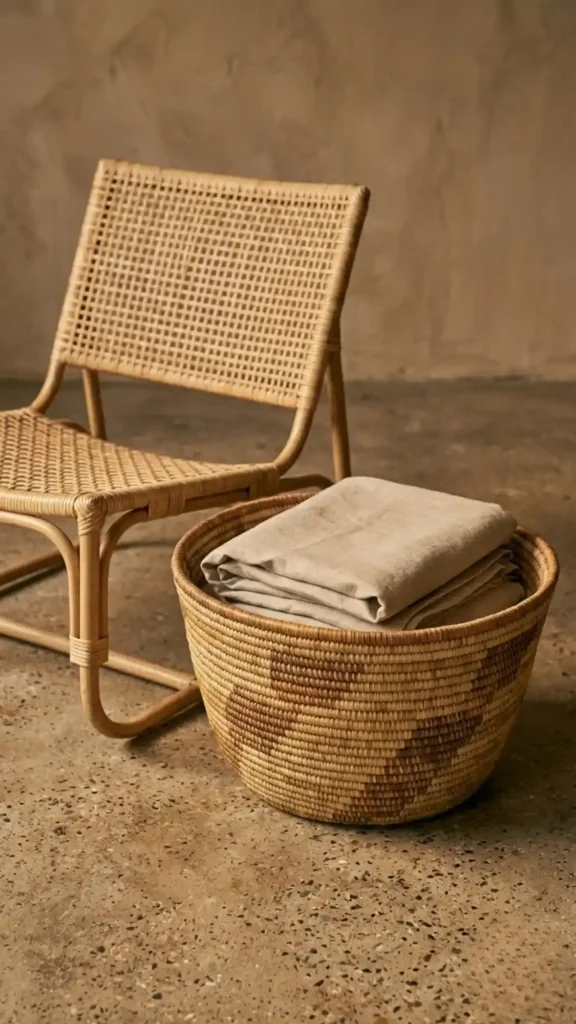
Coiled grass baskets from Southern and East African craft traditions carry the same handmade logic as mud cloth — visible process, natural material, geometric structure.
They function as storage, as decorative objects, and as textural counterpoints to woven fiber pieces. A large floor basket beside a sofa holds throws and is visually present enough to read as a room element, not just a container.
Use them in groups of different sizes or as standalone statement objects. The coil pattern adds another layer of geometric language without requiring wall space or surface area.
12. Introduce Dark Wood as the Color Anchor
12. Introduce Dark Wood as the Color Anchor
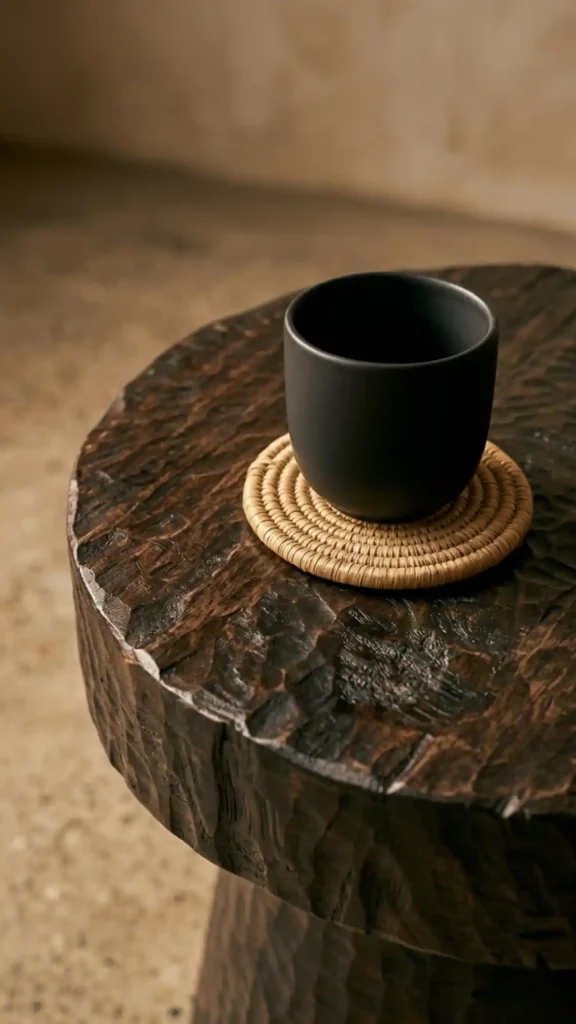
Dark wood — ebony-stained, dark-oiled teak, or natural mango wood — plays the same structural role in furniture that warm black plays in pattern.
It anchors the earth palette, creates contrast against ochre walls and raw linen textiles, and prevents the room from reading as undifferentiated warmth. Without a darker furniture tone, ochre and terracotta tend to blend together rather than each having its own visual territory.
Hand-carved pieces with visible tool marks are preferable to machine-finished furniture. The surface irregularity creates light variation across the wood that smooth factory finishes eliminate.
13. Leave One Wall Section Undecorated
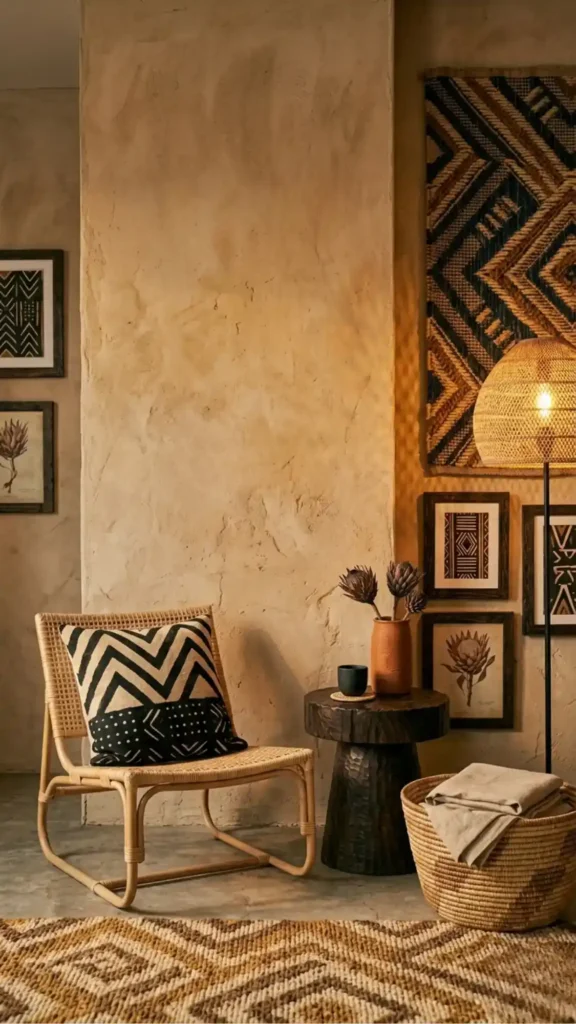
The most common failure in Afro Bohemian rooms is the absence of visual rest.
Every surface activated simultaneously gives the eye nowhere to pause before moving to the next element. One undecorated wall section — plain plaster, a solid matte paint in a palette tone — functions as the breath between the visual statements.
This isn’t decorating conservatively. It’s providing the contrast that makes the decorated sections more legible and more impactful. A woven tapestry reads more powerfully against a bare plaster wall than against another decorated surface competing for the same attention.
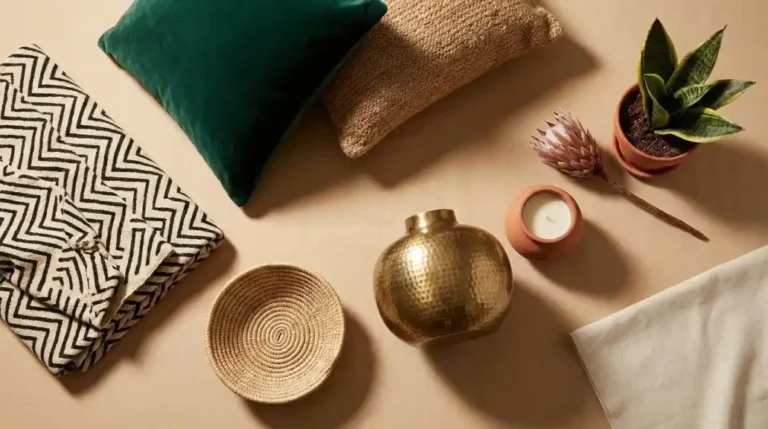
14. Style Vignettes in Odd Numbers
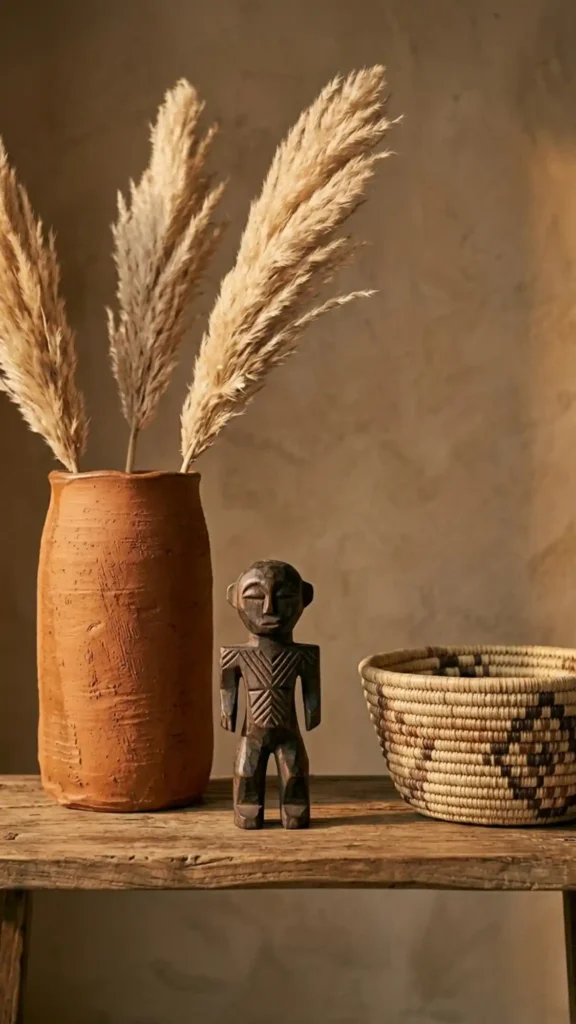
Grouped objects in even numbers create symmetry — and symmetry is visually resolved too quickly.
Odd-number groupings — three objects, five objects — create a slight visual tension that keeps the eye engaged longer. Within the group, vary height, material, and scale: one tall vessel, one mid-height object, one low element. The visual movement between them is what makes a vignette feel curated rather than placed.
In Afro Bohemian design, each object in the group should also carry a distinct material identity: smooth ceramic beside rough woven fiber beside carved wood. Material contrast within the vignette reinforces the broader material logic of the room.
15. Choose Handmade Over Manufactured Wherever Budget Allows
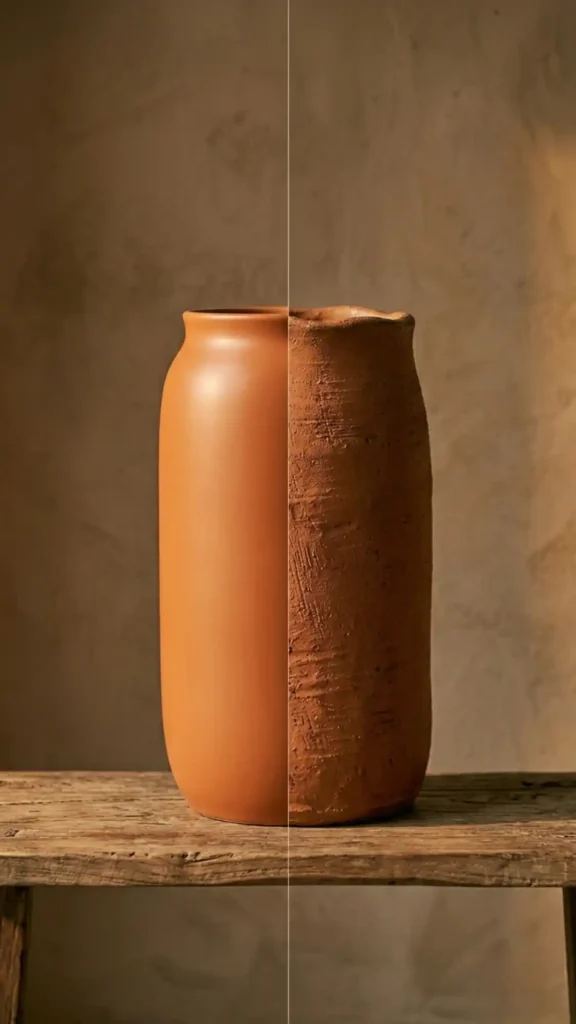
Machine-made objects have surface uniformity — and surface uniformity flattens texture contrast across a room.
Handmade pieces — hand-thrown ceramics, hand-carved wood, hand-knotted rugs, hand-woven textiles — carry slight irregularities that catch light differently at different angles. That differential light response is the physical mechanism behind what people describe as a room having “depth” or “warmth.”
You don’t need an entirely handmade room. You need enough handmade pieces — especially in the most visually prominent positions — that the manufactured pieces recede into the background rather than defining the room’s surface character.
What Your Saves Are Telling You About Which Ideas to Start With
Before buying anything, spend ten minutes with your saved images and answer these questions honestly:
- Are your saved rooms mostly close-up detail shots or full-room compositions? If details, your first move is a textile or object investment — not furniture.
- Which material appears most frequently in your saves — woven fiber, dark wood, or terracotta? That’s your primary material. Lead with it.
- Do most of your saved rooms feel dark and moody or light and airy? This determines your lighting strategy and whether your wall tone should be deep ochre or warm sand.
- Is there one room type — bedroom, living room, styled corner — that dominates your saves? Start there. Don’t spread the aesthetic evenly across the whole house before you’ve landed it somewhere first.
- Do your saved rooms feature more pattern or more texture? Pattern-dominant saves suggest you start with the rug and tapestry. Texture-dominant saves suggest you start with material selection and lighting.
Your saves represent the visual decisions your own aesthetic sensibility has already made. The 15 ideas above are most effective when applied in the order your saves suggest — not in the sequence they appear here.
Explore More:
- Afro Bohemian Interior Design: The Complete Style Guide — Understand the full cultural and material logic behind the aesthetic before applying any of these ideas to your space.
- 11 Afro Bohemian Color Palettes That Actually Work — Once you’ve locked in your three-pigment discipline, use these palette combinations to refine your ochre, terracotta, and indigo balance.
- 9 Common Afro Bohemian Decorating Mistakes to Avoid — These 15 ideas are easy to misapply — here’s what goes wrong most often and how to course-correct before you buy anything.
- How to Create an Afro Bohemian Interior Design Style at Home — A full room-building walkthrough that picks up where these individual ideas leave off.
- How to Mix Soulful Earth Tones in Afro Bohemian Decor — Go deeper on the three-tier pattern scale hierarchy introduced in ideas 5, 7, and 12.
- How to Decorate in Afro Bohemian Style Without Making It Look Busy — Ideas 13 and 7 touch on visual rest and scale — this guide builds the full system around those two principles.
- Afro Bohemian Decor Must-Haves for Beginners — If you’re not sure which of these 15 ideas to start with, this beginner list narrows it down to the non-negotiables.